
Carbony Celtic Whistles
Carbony Celtic Winds comes out of Pipe Makers Union, a shop in Corvallis, Oregon working entirely in carbon fiber. Their own composite, Carbony, carries the old Celtic designs in a material that will not crack or warp the way wood can.
The whistles descend from the Copeland tradition and are endorsed by Michael Copeland himself. A tapered bore gives them a rich, balanced, precise voice, and they are offered from low A up to high G. The mouthpiece is machined from anodized aluminum with a marbled ebonite tip.

Finding the right Carbony whistle
Wider bore
A more robust and slightly louder tone.
Narrower bore
A sweeter response. Bore size shapes the voice — neither is the wrong choice.
Thumbholes
Ordered on the back, either the top alone or both. On a D whistle, the top thumbhole gives a true C natural in place of a cross fingering, and the lower gives an F natural without half-holing, which is welcome in keys such as D minor.
Close finger spacing
Some whistles can be set up with the tone holes sitting closer together, using internal chimneys. Lower pitches benefit most.
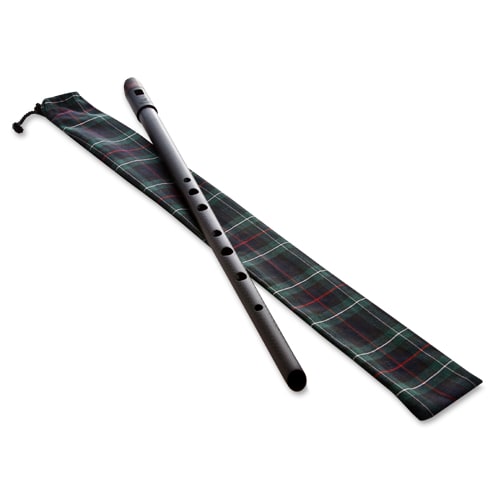
The Great Highland whistle
Pitched at A440 and takes exact Highland bagpipe fingering across two octaves; because the Highland A scale shares a key signature with the D whistle, it holds its own in an Irish session.
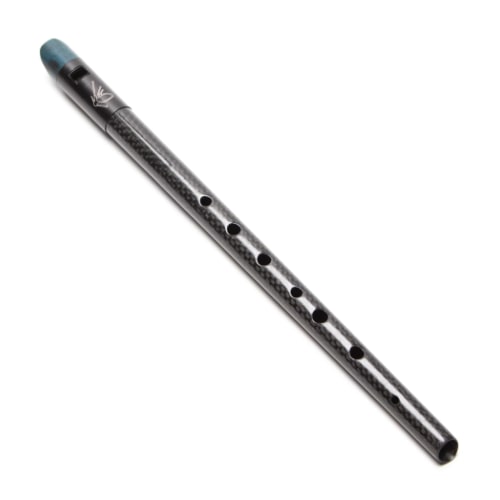
The gaita whistle
In C or D, following the spacing of the Galician puntero, with cross-fingered accidentals.

